
The Factories Act, 1948: Definition, Salient Features, and Significance
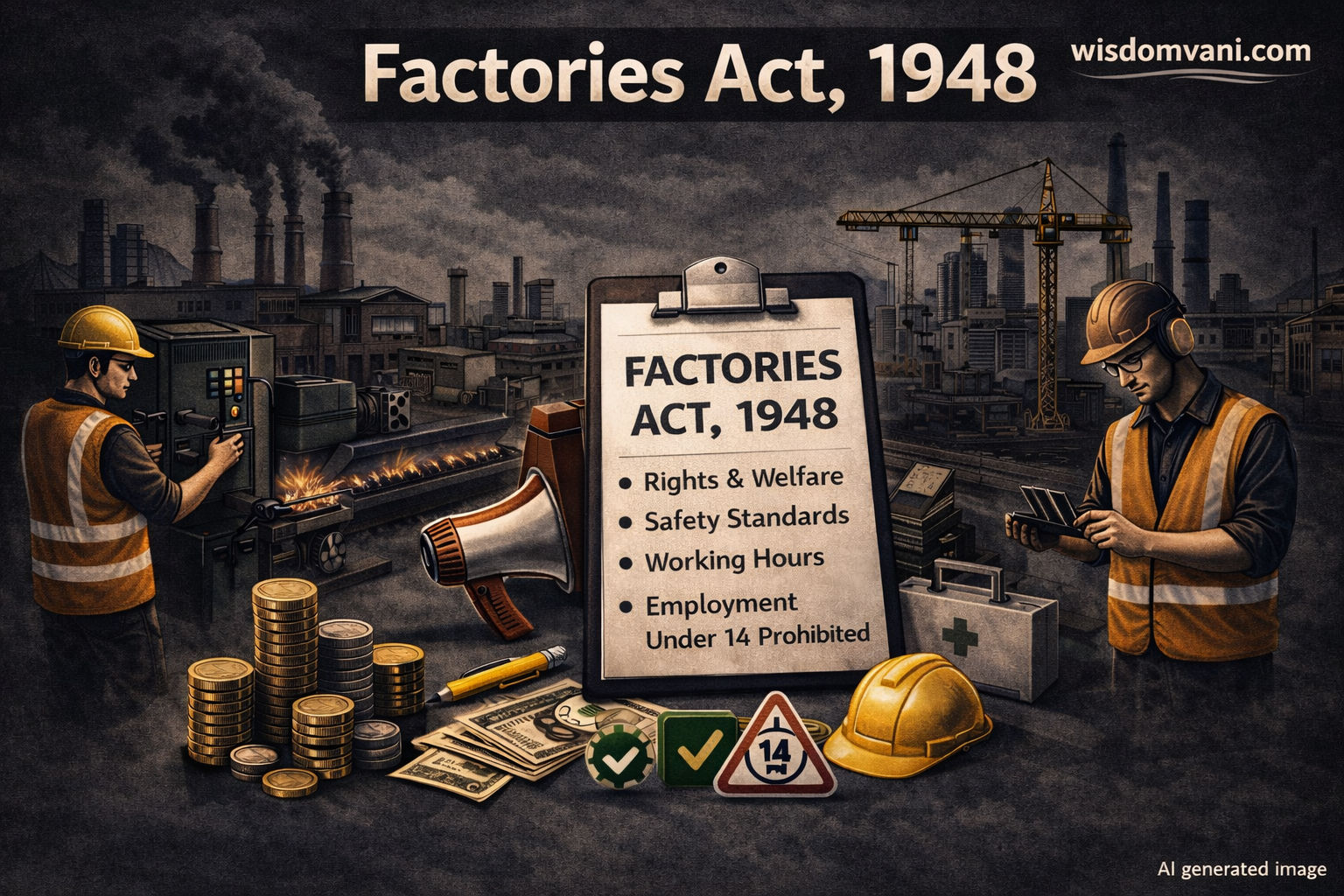
The Factories Act, 1948 is a cornerstone of Indian Labor Law. It is a "Social Welfare Legislation" enacted to protect workers from exploitation and ensure their dignity in the workplace.
1. Definition and Core Objectives
The Act was introduced to consolidate and amend the laws regulating labor in factories. Its primary goals are:
Health and Safety: To ensure workers function in a safe and hygienic environment.
Welfare: To mandate basic human facilities like water, rest, and childcare.
Work-Life Balance: To prevent overworking by strictly regulating daily and weekly hours.
Protection of the Vulnerable: To place special restrictions on the employment of women and children.
2. Scope and Applicability (Section 2)
The Act applies to all of India and covers any premises defined as a "Factory." A premises is a factory if:
With Power: 10 or more workers are employed, and a manufacturing process is carried out using electricity/power.
Without Power: 20 or more workers are employed, and a manufacturing process is carried out manually (without power).
Key Distinction: The "Occupier" is the person who has ultimate control over the affairs of the factory. They are legally responsible for complying with the Act.
3. Salient Features (The Pillars of the Act)
A. Health Provisions (Sections 11–20)
The Act ensures that the factory environment does not become a breeding ground for diseases.
Cleanliness: Floors must be swept daily; walls must be whitewashed or painted once every few years.
Disposal of Waste: Proper arrangements for treating and disposing of industrial effluents and waste.
Ventilation & Temperature: Adequate air circulation must be maintained to keep the atmosphere comfortable.
Drinking Water: Wholesome drinking water must be provided at points clearly marked "Drinking Water" in a language understood by the majority of workers.
Latrines & Urinals: Sufficient, clean, and separate toilets for male and female workers.
B. Safety Provisions (Sections 21–41)
Safety is non-negotiable. The Act mandates:
Fencing of Machinery: Every dangerous part of a machine must be securely fenced with substantial construction.
Young Persons on Machines: No "young person" (between 15–18) can work on dangerous machines unless they have received full training and are under supervision.
Casing of New Machinery: All moving parts must be encased to prevent contact.
Fire Safety: Every factory must have an escape route and firefighting equipment ready for use.
Safety Officer: If a factory employs 1,000 or more workers, it is mandatory to appoint a Safety Officer to monitor risks.
C. Welfare Provisions (Sections 42–50)
The Act looks beyond physical safety to the social well-being of the worker:
Washing Facilities: Adequate and clean facilities for washing, separate for men and women.
First-Aid: At least one first-aid box for every 150 workers. If a factory has 500+ workers, an Ambulance Room with a qualified doctor/nurse is mandatory.
Canteens: If the factory employs more than 250 workers, a canteen must be provided and maintained.
Creches: If there are more than 30 women workers, a room for their children (below age 6) must be provided with adequate lighting and ventilation.
Welfare Officer: Mandatory if the factory employs 500 or more workers.
D. Working Hours and Leave (Sections 51–66)
To prevent labor exploitation, the Act sets strict limits:
Weekly Hours: Not more than 48 hours per week.
Daily Hours: Not more than 9 hours per day.
Intervals for Rest: No worker should work for more than 5 hours without a break of at least 30 minutes.
Overtime: Any work beyond 9 hours a day or 48 hours a week must be paid at double the ordinary rate of wages.
Prohibition of Night Work for Women: Women are generally not allowed to work between 7:00 PM and 6:00 AM (exceptions exist via state notification).
4. Significance of the Act
The importance of this legislation cannot be overstated in a developing economy like India:
Industrial Peace: By protecting worker rights, the Act reduces strikes, lockouts, and industrial disputes.
Economic Productivity: Healthy and safe workers are more efficient. The Act links worker welfare directly to the nation’s industrial output.
Human Rights at Work: It enforces the constitutional right to "just and humane conditions of work" (Article 42 of the Indian Constitution).
Accountability: It holds the management (Occupier) personally liable for negligence, ensuring that safety is not ignored in the pursuit of profit.
Child Labor Prevention: It strictly prohibits the employment of children below the age of 14, aligning with international labor standards.
5. Summary Table for Quick Reference
| Category | Provision | Threshold/Limit |
| Applicability | With Power | 10+ Workers |
| Applicability | Without Power | 20+ Workers |
| Max Working Time | Daily Limit | 9 Hours |
| Max Working Time | Weekly Limit | 48 Hours |
| Canteen | Mandatory for | 250+ Workers |
| Creche | Mandatory for | 30+ Female Workers |
| Welfare Officer | Mandatory for | 500+ Workers |
| Safety Officer | Mandatory for | 1000+ Workers |
Conclusion
The Factories Act, 1948, is not just a set of rules; it is a shield for the "working class." It balances the power between the employer and the employee, ensuring that industrialization does not come at the cost of human life or health.
Comments 0